
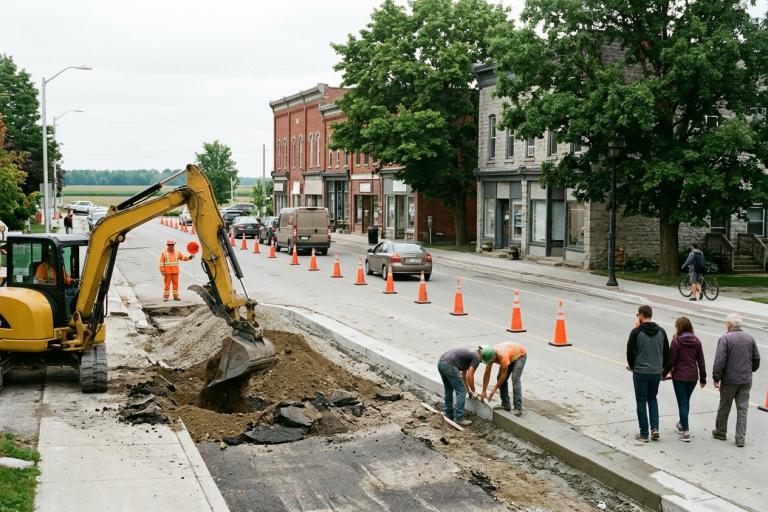
How the City plans road construction
The City coordinates a variety of construction projects over the active construction season, which runs from May 1 to November 14. We schedule roadway, water, drainage, and utility work together to minimize disruptions and use resources efficiently. Because each ward has different needs, you may not see every type of project in your neighbourhood every year. All projects are prioritized based on the condition of the road network and are included in the annual budget process.
Active projects and road treatments
The City maintains approximately 185 lane kilometres of road. We use two main programs to keep the network in good shape:
- Residential Road Renewal Program (RRRP): Focuses on local streets. Inspectors check the pavement, sidewalks, and curbs annually to decide the best treatment.
- Street Infrastructure Renewal Program (SIRP): Targets major arterial and collector roads. These are inspected every three years by an external consultant.
Depending on the condition of your street, crews may use one of the following treatments:
- Surface treatment: A thin layer of asphalt is placed over the existing road. This extends the life of the road by about 10 to 12 years and is used when the road is in fair to good condition.
- Rehabilitation: The top layer of asphalt is milled and replaced. In minor rehabilitation, only some curbs, gutters, and catch basins are replaced. In major rehabilitation, all curbs, gutters, and catch basins are replaced along with the asphalt.
- Rebuild: Used when the road and sidewalks are in poor condition. The entire road infrastructure, including curbs, gutters, and catch basins, is removed and replaced. This is also when we upgrade aging underground water and sewer pipes.
What to expect when construction is on your street
Residents living on a street with planned work will receive a letter in advance. The letter explains the type of work, the estimated timeline, and what you need to do. If crews are doing emergency work, such as fixing a water main break, you may receive a notice in your mailbox or on your door.
Yard and property preparations
- Mark underground sprinkler heads so crews can avoid damaging them. You do not need to remove the sprinkler system.
- Move items located within two metres of the edge of the sidewalk. This includes fences, plants, shrubs, flowers, lawn decorations, retaining walls, and railway ties. Anything left in the work zone when construction begins will be moved by the City. The City is not liable for damage to items left in the construction area.
- Disturbed landscape areas will be restored with grass seed or sod to City standards. Any damage to driveways, private walkways, or sprinklers will be repaired during the landscaping phase, which typically happens within 12 months after the road work is finished.
Driveways and parking
- Access to your driveway may be restricted during certain phases of construction. You will receive advance notice if your driveway will be temporarily closed.
- After construction, driveways and private walkways will be reinstated following City standards. We do not install specialty surfaces like exposed aggregate or stampcrete. If a specialty surface is damaged, it will be removed and replaced with a sand and rock mixture. You will receive a fair market payment to replace the material yourself.
- Before construction begins, crews may install no parking signs and complete visual inspections. Watch for further notices in your mailbox with details about start dates, garbage and recycling pickup changes, and traffic restrictions.
Sidewalk and curb maintenance
The City uses several methods to keep sidewalks safe and level:
- Grinding: Raised portions of the sidewalk are ground down to remove trip hazards. This can only be done two to three times before the sidewalk structure is compromised.
- Concrete replacement: Damaged panels are removed and new concrete is poured. This is used when the damage is too severe for grinding or mudjacking.
- Mudjacking: If a section has sunk, crews fill the space underneath with grout to raise it to the correct height. This works best on sidewalks that are mostly free of cracks and have a concrete gutter.
- Asphalt capping: A layer of asphalt is placed over a sidewalk to quickly fix trip hazards and provide a smooth surface.
Stay informed
We post updates about active projects, including road closures and construction maps, on the City website. You can also track progress for specific corridors like Corvid Way, Benchlands Drive, and Ambrel Lake Road.
If you have questions about construction in your area, contact the Roads & Winter Maintenance team at 519-555-0100 or email [email protected]. For after-hours utility emergencies, call 519-555-0111.